Goopy Gyne Bagha Byne: The Trilogy in Order and Where to Watch
Three films, two singers, one king of ghosts, and the order to see them in.
Watch the Goopy Bagha trilogy in the order it was released: Goopy Gyne Bagha Byne (1969), then Hirak Rajar Deshe (1980), then Goopy Bagha Phire Elo (1992). Satyajit Ray directed the first two, and his son Sandip Ray directed the third from a screenplay and score Satyajit Ray wrote.
The three films were made across twenty-three years, and they are not a planned series in the way a modern franchise is. Goopy Gyne Bagha Byne was a children's adaptation that became one of Ray's most commercially successful films. Hirak Rajar Deshe came eleven years later and turned the same two singers loose on a tyrant. Goopy Bagha Phire Elo arrived twelve years after that, with the same two actors now visibly older. What holds them together is the pair itself: Tapen Chatterjee as Goopy and Rabi Ghosh as Bagha, in all three.
The Goopy Gyne Bagha Byne films in order
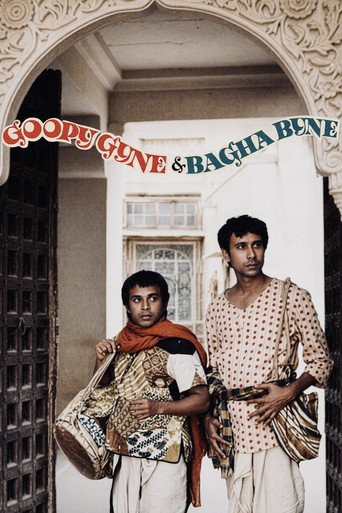
Goopy Gyne Bagha Byne (1969). Directed by Satyajit Ray, released on 8 May 1969. Goopy, a grocer's son who cannot sing, is thrown out of his village of Amloki. In the forest he meets Bagha, thrown out of his own village for drumming badly. The king of the ghosts grants them three boons: food and clothes whenever they clap, slippers that carry them anywhere, and music that freezes everyone who hears it. They land in the kingdom of Shundi just as its neighbour Halla, whose king has been drugged by his own minister, is preparing to invade. Santosh Dutta plays both kings, who turn out to be brothers, and Harindranath Chattopadhyay plays Borfi, the magician behind the potion.
Hirak Rajar Deshe (1980). Directed by Satyajit Ray, released on 19 December 1980, produced by the Government of West Bengal. Goopy and Bagha, bored of palace life, accept an invitation to sing at the Diamond King's anniversary celebrations. Utpal Dutt plays the Hirak Raja, who hoards diamonds while his miners and farmers go hungry, and who sends anyone who disagrees into the Jantar Mantar, a brainwashing chamber. Soumitra Chatterjee plays Udayan Pandit, a schoolteacher on the run because he will not stop teaching. The two singers join him, and the film ends with the king's own statue being pulled down.
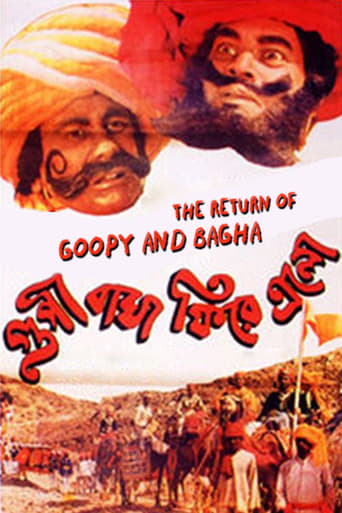
Goopy Bagha Phire Elo (1992). Directed by Sandip Ray, released on 3 January 1992. Satyajit Ray wrote the screenplay and composed the music and lyrics, as he had for the first two. Goopy and Bagha, older and restless, travel to Anandapur, where a sorcerer named Brahmananda Acharya, played by Ajit Bandyopadhyay, tricks them into stealing precious stones with the promise that he will make them young again. A dream visit from the king of the ghosts turns them around, and a boy named Kanu becomes the key to defeating the sorcerer.
Where the story came from
The characters were not Satyajit Ray's invention. They come from a story by his grandfather, Upendrakishore Ray Chowdhury, who founded the children's magazine Sandesh. Wikipedia dates the characters' first appearance in Sandesh to 1915, with Upendrakishore's own illustrations. Ray took the story's bones for the 1969 film and wrote both sequels himself.
That family line runs through the whole trilogy. The grandfather wrote the story, the grandson filmed it, and the great-grandson finished the series. Sandip Ray had worked with his father for years before directing Goopy Bagha Phire Elo, and he later took on Feluda, his father's detective, in a long run of films of his own.
What each film is doing
The first film is a fairy tale with songs, and the songs are the reason it lasts. Ray wrote the music and the lyrics, and Anup Ghoshal sang for Goopy. The film was shot in black and white, and only its final scene is in colour, a choice Wikipedia attributes to the budget. Its most famous sequence is the ghost dance, about six and a half minutes long, in which four kinds of ghost dance in turn to music built on South Indian classical instruments. It is strange, funny and faintly frightening, which is roughly what a good children's story ought to be.
The film won the President's Gold Medal for the best feature film and the award for best direction at the 16th National Film Awards, which honoured films of 1968. That is why some sources list the film as 1968 and others as 1969: it was certified in one year and reached cinemas in the next.
Hirak Rajar Deshe is the sharper film. Much of the dialogue is in rhyme, which makes it easy to quote and easy for children to follow, and it lets Ray say pointed things about power in the form of nursery verse. The king's ministers speak in couplets, the brainwashed recite slogans, and the Jantar Mantar is played for comedy right up to the moment it is used on schoolchildren. Wikipedia's article on Ray describes the Diamond King's kingdom as an allusion to India during the Emergency. That is a reading rather than a stated fact, but it is a common one, and the film makes no effort to discourage it. At the 28th National Film Awards it won best Bengali feature film, best music direction for Ray, and best male playback singer for Anup Ghoshal.
Goopy Bagha Phire Elo is the gentlest of the three. It is less concerned with kings than with getting older, and with what a pair of wandering musicians do once they have everything the first film promised them. Coming twelve years after Hirak Rajar Deshe, with Tapen Chatterjee and Rabi Ghosh playing the roles again, it works partly as a reunion. It won several Bengal Film Journalists' Association awards in 1993, including best music.
Is there a fourth film?
Not so far. In 2013 Sandip Ray told The Times of India that a Goopy Bagha film without Tapen Chatterjee and Rabi Ghosh was unthinkable, and that the only way to make a fourth would be to move the story on to the pair's sons. No such film has been announced as in production.
The characters have travelled in other forms. Goopi Gawaiya Bagha Bajaiya, a Hindi animated film directed by Shilpa Ranade and based on Upendrakishore's characters rather than on Ray's films, premiered at the Toronto International Film Festival in 2013 and was released in India in 2019.
Restoration
The Academy Film Archive holds preservation masters for a large part of Satyajit Ray's work, and Wikipedia records that it preserved Goopy Gyne Bagha Byne in 2003. We could not find a restoration of Hirak Rajar Deshe or Goopy Bagha Phire Elo documented by the Academy or by the Film Heritage Foundation, and we found no announcement of a new restoration of any of the three in 2025 or 2026. If one is announced, the films' pages here will say so.
Where to watch the Goopy Bagha trilogy
As of September 2026, JustWatch India lists Goopy Gyne Bagha Byne as free to watch with ads on Plex. It lists Hirak Rajar Deshe on Amazon Prime Video by subscription, and Goopy Bagha Phire Elo on Amazon Prime Video and Vi Movies and TV, also by subscription. These listings change without notice, and a free copy of an old film is not always a good one, so check the running time and picture before settling in.
Each film's page on Cholochitro Diary carries dated streaming links, and it is the quickest way to check whether anything has moved since this was written.
If the trilogy works for your household, the natural next step is Sonar Kella (1974), Ray's first Feluda film, which is also an adventure a child can follow, with a boy at the centre of it. Our guide to where to watch every Satyajit Ray film covers the rest.